
Food, Music and Enlightenment
The Civil Rights Trail Chapters
A seven-part series documenting our journey along the trail.
Chapter Three: Juke Joint Festival – Clarksdale, Mississippi
Chapter Four: Mound Bayou – Mississippi
Chapter Six: Montgomery, Alabama — The Epicenter of the Movement
Posted December 15, 2024 – Narrated by Jim

In his book, The Black Church: This is Our Story, This is Our Song, Henry Louis Gates Jr. calls Montgomery, Alabama, “The Epicenter of the Civil Rights Movement”

In 1955, Martin Luther King Jr. was the pastor of the Dexter Avenue Baptist Church in Montgomery when, Rosa Parks, just down the street, refused to surrender her seat on the bus to a white passenger.

Rosa Parks bravery – in response to the brutal murder of Emmett Till three months’ earlier – activated the Civil Rights Movement.

Montgomery, Alabama

With so much to learn and see in the Montgomery area, we easily filled two weeks with sightseeing, museums, restaurants and lectures.

Here we will share our visits to The Legacy Museum, National Memorial for Peace and Justice, Rosa Parks Museum, Freedom Rides Museum, Civil Rights Memorial and Center, Selma’s Edmund Pettus Bridge, the Capitol Building, and the Tuskegee Airmen National Historic Site.
The Legacy Museum

Other than the capitol, The Legacy Museum draws the most visitors to Montgomery. In 2018, this museum opened two separate sites, both hailed world-wide as architectural masterpieces.
These museums combine art and facts to guide visitors through the hidden but undeniable history of slavery, abolition, the Civil War, reconstruction, Jim Crow, Civil Rights, and the mass incarceration of Black people.
You can leave this museum, but it will never leave you.

(Stock photo since photography is not allowed inside the museum)
Here is a short video introduction.
Their website states:
“On the site of a cotton warehouse where enslaved Black people were forced to labor in bondage, the Legacy Museum tells the story of slavery in America and its legacy through interactive media, first-person narratives, world-class art, and data-rich exhibits.”
Alabama is Carmen’s birth-state where her family roots run deep in the beautiful red clay. Since our visit to Montgomery, we have a more clear-eyed view of the staggering price of racism and the social dysfunctions it perpetuates from gender inequality to the collapse of the middle-class.

(Stock photo since photography is not allowed inside the museum)
This museum is like a difficult sermon we needed to hear. The evidence is stacked to convince and confront without anger or malice.

(Stock photo since photography is not allowed inside the museum)
Like the sacraments, the ugly truth is exposed and lain out with loving hands. And, there is healing in it.


Life sized sculptures and images evoke empathy and, sometimes the need to turn away to explore the wall exhibits where even more powerful and shocking archived data corner you with no place to run.

(Stock photo since photography is not allowed inside the museum)
This museum is an essential stop on the Civil Rights Trail.

The stunning artistry, architecture and cinematic media made our four hour visit feel like a journey, and us the better for it.

(Stock photo since photography is not allowed inside the museum)


(Stock photo since photography is not allowed inside the museum)


(Stock photo since photography is not allowed inside the museum)

(Stock photo since photography is not allowed inside the museum)

(Stock photo since photography is not allowed inside the museum)

Entrance to the Legacy Museum includes a visit to the:
National Memorial for Peace and Justice
This six-acre outdoor memorial is dedicated to the legacy of Black Americans who were executed without legal representation by mobs acting under the pretense of serving justice.

We took about two hours here to walk through the site and study the sculptures and engravings. We wish we had scheduled more time.

The purpose of lynching is to invoke terror.

The names of the lynched men and women are engraved on more than 800 steel monuments…


one for each county where a racial terror lynching took place.

This memorial documents nearly 6,500 racial terror lynchings in every American state between 1865 and 1950.

Rosa Parks Museum
We were the first generation to be taught the Rosa Parks story in grade school and how making “good trouble” can change the world.

Utilizing a replica of the actual bus and a series of videos located in each bus window, the museum dramatically recreates the arrest of Rosa Parks on December 1, 1955 as she refuses to surrender her seat in the dedicated ‘colored’ section, to a white man.


Four days later, Rosa Parks’ refusal to obey Jim Crow law set off the famous Montgomery Bus Boycott, a one-year protest heralded as the first large-scale demonstration against racial segregation in the United States.

The Rosa Parks Museum honors her role in the Civil Rights Movement, and her dedication and leadership in the decades that followed.

Here’s a short video of the museum.
Freedom Rides Museum
The Freedom Rides Museum is located in the old Greyhound Bus Station.

Here is where The Freedom Riders – 20 young college students, black and white – arrived on May 20, 1961 to peacefully protest segregation by exchanging assigned BLACK and WHITE waiting areas.

Well schooled in the technique of non-violence, they were as prepared as they could be when they stepped off the bus and were immediately attacked by an all-white mob. Many were beaten – some to unconsciousness – and wounded.

A little more than a year later, the federal government declared: “No longer did African-Americans have to sit separately or use separate waiting rooms and restaurants.”

While exploring the museum we asked Dorothy Walker, the director, if she knew our San Diego friend, Taran Gray, co-writer of the new hit musical The Freedom Riders, nominated for a Grammy Award. Of course she knew him. Name-dropping is fun.

Discussing the Freedom Riders watershed event, Reverend Dr. Martin Luther King, Jr. declared, it was “a psychological turning point in our whole struggle.”
Civil Rights Memorial and Center
The Civil Rights Memorial and Center is located in the middle of downtown Montgomery.

The Civil Rights Memorial is a fountain in the form of an asymmetric inverted stone cone.

A thin veil of water flows over the base of the cone engraved with the 41 names of civil rights martyrs, including a quote from Dr. Martin Luther King, Jr.

Inside, the “Wall of Justice” displays names as they cascade down a room-size screen in a simulation of the water flowing over King’s words on the Memorial outside. Each name was added by someone who has made a personal decision to work for justice in their own life.
The four inside galleries focus on the martyrs stories and a quiet space for prayer and reflection.

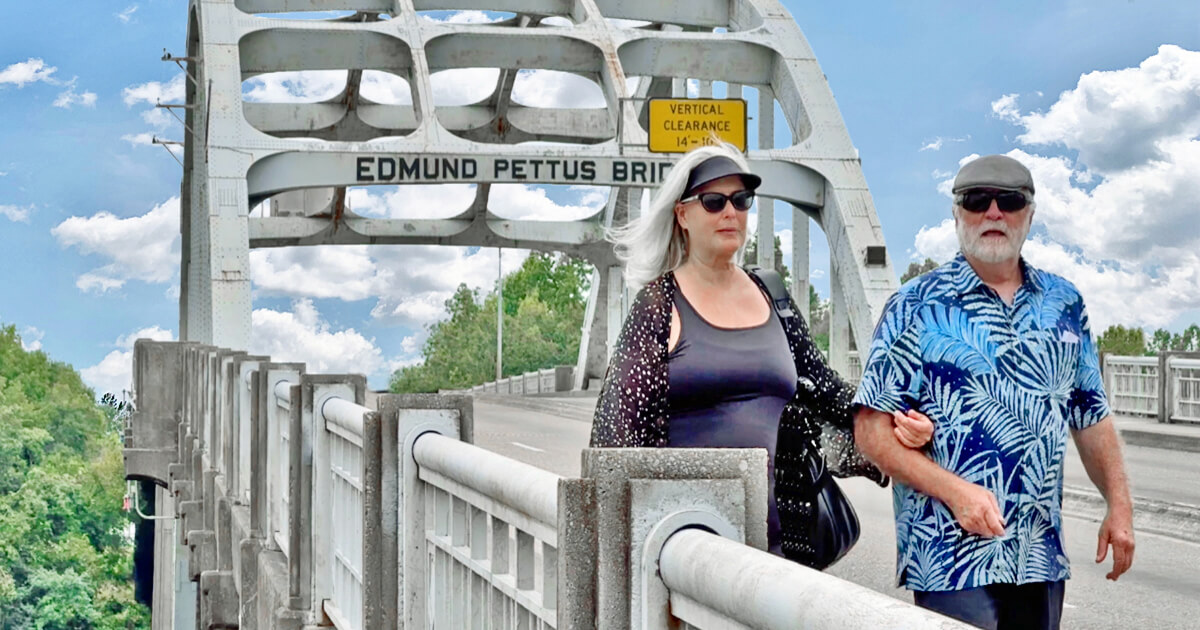
Selma’s Edmund Pettus Bridge
54 miles away from Montgomery, in Selma, a bridge crosses the Alabama River. It is named for Edmund Pettus, a former Confederate general and the Grand Dragon of the Alabama Ku Klux Klan.

In 1965, the bridge became the site of three historic marches and, most notably, the horrible events on a march known as Bloody Sunday.

On March 7, 1965, as 600 unarmed voting rights advocates, led by John Lewis and Hosea Williams, marched peacefully across the bridge,

a wall of state troopers, wearing white helmets and wielding billy clubs stretched across Route 80 at the base of the span.

The event was nationally televised by news media.

Troopers used tear gas, clubs, whips and ropes, horses and attack dogs to turn back the peaceful, unarmed demonstrators.

John Lewis remembers Bloody Sunday, the seminal violent event that shocked a Nation and sent 17 marchers to the hospital and dozens more treated for injuries.
As we walked over the bridge, we could sense the historical significance of good trouble walking toward bad trouble. The fear of expressing your power by holding your ground, knowing that your constitutional rights must be certified in order to transfer those rights to the next generation one bloody step at a time. Freedom is not free.

Eighteen days after Bloody Sunday, March 25, 1965, protesters marched 54 miles from Selma to downtown Montgomery.
Capitol Building
At the end of the march, a crowd of 25,000 gathered around the steps in front of the Capitol building…

As Dr. Martin Luther King, Jr. made his famous “How Long Not Long” speech.

We wanted to feel those steps beneath our feet and imagine the excitement of that day when truth confronted power with unconditional love and unwavering purpose.

Tuskegee Airmen National Historic Site
While not directly associated with the Civil Rights Movement, forty miles from downtown Montgomery is the Tuskegee Airmen National Historic Site at Moton Field.

The Tuskegee Airmen were the first Black military unit of aviators in the U.S. Army Air Corps (AAC), a precursor of the U.S. Air Force.

Trained at the Tuskegee Army Air Field in Alabama starting in 1941, they flew more than 15,000 individual sorties in Europe and North Africa during World War II.


The museum offers the opportunity to hear their stories, some in the voices of the actual airmen who were still alive when the museum opened.

Colonel Charles McGee stated in 2005, “They said we didn’t have the intelligence, demeanor, the courage to be combat pilots. They learned different. All we needed was a chance and training.”

Their impressive performance earned them more than 150 Distinguished Flying Crosses, and helped encourage the eventual integration of the U.S. armed forces.

Southern Cooking
We’d be lying if we said we went on The Civil Rights Tour for the history alone. Even before we left California we knew how this would go down. If you go to Montgomery – and we hope you do – eat with love and abandon. It’s all part of the healing process. And if you visit one of the restaurants below, please give them a hug for us.


In conclusion
As children in the 60’s, we watched these events on television and over the years it all became a blur.

Montgomery helped us to sort out the details and fill in the gaps of our memories.

Each museum specializes in a specific area of the struggle for civil rights, and together, they hold an epochal human rights crisis in stasis so visitors can examine the social value of intentional nonviolence.

We were struck by the difference between the number of lives lost in The Movement (41) and the human toll of the Vietnam Conflict (2.5 million). If civil wars were measured in the least blood spilled and the most constructive political and social reforms, then the war for Civil Rights is certainly a success story for the ages.

Though The Civil Rights Trail is about Black History and the struggle for basic human dignity, it is also a map to America’s armory where the world’s most potent and effective defender of democracy is kept, ready for action: People Power.

You can see our exact route on this map.
*photos in this post (unless otherwise noted) were taken and copyrighted by Living In Beauty.
Follow “Living In Beauty” by Email
Enter your email address and receive notifications of new posts by email, about once or twice a month. We will not sell or share your email address, and you can unsubscribe at any time.
