
Food, Music and Enlightenment
The Civil Rights Trail Chapters
A seven-part series documenting our journey along the trail.
Chapter Three: Juke Joint Festival – Clarksdale, Mississippi
Chapter Four: Mound Bayou – Mississippi
Chapter Six: Montgomery, Alabama — The Epicenter of the Movement
Posted February 19, 2024 – Narrated by Carmen
“This is where healing begins”
Our Civil Rights Trail tour began with the Emmett Till Memorial – a good place to start, for several reasons.

First, the murder of Emmett Till launched the Civil Rights movement.

Second, our destination for the night, The Emmett Till Historic Intrepid Center, was a scenic Sunday drive from Dad’s house in Decatur, Mississippi.

Third, it was Spring – the most beautiful season in Mississippi – when it is customary to reflect on new beginnings, redemption, and reconciliation – these are ideal conditions to immerse in the life-and-death story of Emmett Till.

In grade school, the story of Emmett Till served as our “Aha!” moment about racial inequity in America. We’d already deduced that something was off, and Emmett Till filled us in on the secret.

In the mid-60’s, Emmett would have been in his mid-20’s – younger than my parents.

If Emmett had been born a couple of years later, he’d have been a Boomer. If he’d just not gone to Mississippi and never set foot in that store to buy candy where he laid eyes on Carolyn Bryant, then maybe today he’d be an 83 year-old COVID survivor sending those goofy nostalgic emails to his grandkids about the good ol’ days.

Emmett Till was The Death of Innocence.
Ours was the first generation with a horror story in our American History books that eclipsed the chilling stories of Hawthorn, Poe, Shelley and Hitchcock, and continues to transcend King, Kubrick, Tarantino …

Every kid’s worst nightmare occurred less than a month after Disneyland’s Grand Opening, on a Chicago teenager’s Summer of ’55 family vacation to Money, Mississippi.

One minute Emmett is sleeping peacefully in bed beside his cousin, Simeon, at his Uncle Mose’s house on Dark Fear Road. The next minute he is abducted in the dead of night by two men he’s never seen before. In a dramatic time-stopping moment of irony, the kidnappers pause to watch Emmett slowly put on his socks. Nevertheless, he is thrown in The Truck of Torture to suffer through The Night of Terror where he is afflicted by such heinous violence that, for 69 years, the silent scream for justice has not paused for breath.

It is estimated that more than fourteen people were involved in Emmett Till’s lynching, but the FBI closed the case sixty-six years later on December 6th, 2021 without a single conviction.

Emmett Till – a likable kid, with the cool nickname, Bobo – naively walked straight into some seriously messed-up adult trouble.

Many children can readily identify with grown-ups blowing something completely out of proportion, and even taking licks for a wrong they didn’t commit. Emmett Till’s story almost sounds like a cautionary tale for precocious teens – that is, until you get to the lynching part.

Jim and I both have deep roots in Mississippi. Emmett’s story intersects, somewhat, with our own.

Like Emmett, we never lived in the Deep South, but every summer we visited family there. We know what it is to bask in the attention of southern cousins who are intrigued by our accents (“Say, dog … Say cat …”) and quiz us about what it’s like to live in a city (“Have you ever seen a movie star?”) while the silent issue of racism hangs heavy in the air.

In the early 60’s, at the public pool in Port Gibson, Mississippi, Jim noticed dozens of Black kids, waiting in the hot sun on the opposite side of the chainlink fenced pool. When the midday heat began to subside, the lifeguards told everyone to exit the pool for “colored swimming hour.”

In the 80’s my dad, Allen Perry, spearheaded school consolidation (resulting in desegregation) in Newton County, Mississippi. In the early 90’s, the small town threw a street party in front of the courthouse to celebrate a new era of better educational opportunities for all.

As I strolled along the decorated store fronts, I spotted a white friend talking with his Black schoolmate. I waved to them and crossed the street, eager to join the conversation. But, upon approach, the Black high-school student lowered his head and awkwardly averted his eyes. My friend introduced us but I never shook hands or even exchanged eye contact with the Black student. “What’s this,” I thought, “severe shyness?,” as I politely stepped away to mingle elsewhere. Later, my friend explained the harsh realities of being a Black male in Mississippi.

Sick to my stomach, I grappled with conflicting emotions. Dad’s important civic work involved risk to himself and his family. But if a Black male high-school student cannot look a 30-something year-old white woman in the eye without fear, can all this hard-earned progress be a lasting endeavor? Mississippi is my family’s beautiful ancestral home, but how can people effectively function in a culture where at any moment, a woman can serve (even without her knowledge) as a tool for extremists looking to cause someone (even a child) serious harm ?

That was thirty-five years ago. Today, in Newton County and throughout Mississippi, enlightened citizens are enjoying improvements in race relations, the likes of which, I had never expected to see in my lifetime. Furthermore, communities are equipping themselves for sustainable peace.

The Civil Rights Trail is all about this healing – placing the wounds of the past in a safe public space where people with genuine intentions can come to address their experience and explore ways to make community better for everyone.
Bryant’s Grocery Store & Meat Market
If not for the Mississippi Freedom Trail roadside marker, we’d have missed it.

Draped behind a weeping veil of kudzu, the notorious corner store is barely visible from the road.

The gothic decay of Bryant’s, exposes the breath and bones of this living memorial serving a death row sentence.

This site is the recommended overture to the tragic Emmett Till story.


Glendora, Mississippi

Not far from Bryant’s Grocery is Brave little Glendora. A truth-forward kind of town.

For decades the locals have shouldered heavy pressure to just let the hate crime fade away. Largely due to their efforts, Emmett Till is core to the Civil Rights Movement. Like the open-casket funeral, Emmett’s truth is open for all in Glendora.

To emphasize that this isn’t dusty old history. Emmett’s accuser Carolyn Bryant died two weeks after we pulled into Glendora.

It was eerily quiet.

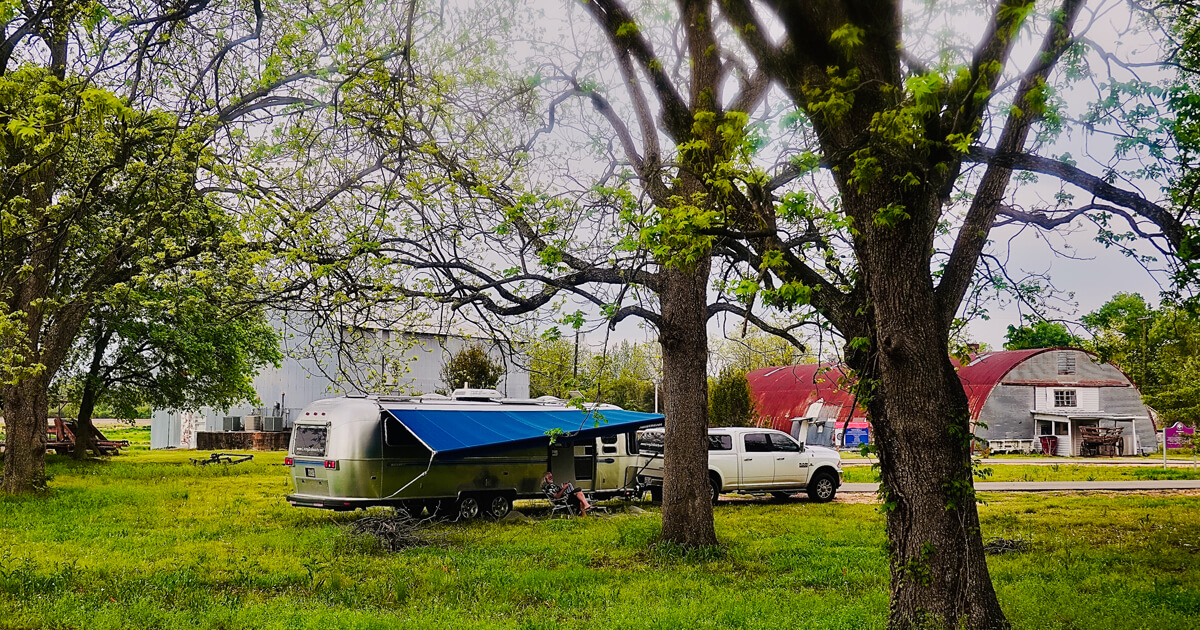
As members of Harvest Hosts, we were invited to park overnight on the site where, disputably, Emmett’s murderers stole a heavy cotton gin fan to anchor his body to the bottom of Black Bayou on August 28, 1955.


Considering all this, we settled in as best we could …

while the Delta sunset painted the sky a biblical shade of red.


When darkness fell, we retired into Beauty to watch, Women of The Movement and videos of Sonny Boy.

Glendora is proud to be the home-town of Sonny Boy Williamson II, King of The Harmonica. Even if you’re not into The Blues, you’ve just gotta love Sonny Boy.
As a young post-war musician, Robbie Robertson, (who was recently awarded a posthumous Oscar for his score in Killers of The Flower Moon), recalls a fascinating encounter with the legendary Sonny Boy.
The Emmett Till Historic Intrepid Center
The following morning, Mayor Thomas guided us on a tour of The Emmett Till Historic Intrepid Center.

We viewed an introductory film explaining the delicate racial dynamics of The Delta in the mid-1950’s. The museum is designed to draw visitors into Emmett’s experience – to imagine walking in his steps.

Reconstructions of articles from that terrible night are on display, including the truck used to abduct Emmett.

Later that morning we pulled out of Glendora and drove 12 miles to the next site.

Sumner Court House
Driving along the bayou toward Sumner, the expansive Delta sky started to tear up.

Expecting a downpour, we parked beside the courthouse…

and ducked into the popular and cozy Sumner Grille for a bite.


After lunch, we’d planned to pick up some rice grits from Two Brooks Farm, but the store was closed. So we walked directly across the road to the Emmett Till Interpretive Center which is (thanks to a benefactor) now under complete renovation.

Documentation, and a dedicated and knowledgeable staff are the strengths of this important museum. After perusing the collection …


we walked across the street to tour the courthouse where justice for Emmett Till hit a brick wall.


An inmate gave us a tour of the interior, answering all of our questions about the preservation project …

and highlighting features such as, the jury box for the all-white jurors; the Black seating area; where Emmett’s mother, Mamie Till sat,

and where Mose stood to identify Emmett’s murderers for the court.


When the perpetrators were acquitted, less than a month after their murderous work, the world sat on edge, waiting for new evidence to surface. But hope waned with each passing decade.

Those who were knowingly and likely involved are all deceased. Justice failed, but Emmett Till is still on the move.
Memorial Statue in Greenwood
The 1955 photo that shocked the world is merely his chrysalis. Emmett Till has emerged at last from the murk and chaos of Jim Crow horror and is transformed into a contemporary American folk hero. He is jaunty, at ease, and conspicuously himself.

The art of the horror genre is to fetishize hope to initiate more horror. That is not Emmett Till’s story. His monstrous wounds shocked the world, but his legacy is more than his wounds. Here, he is himself – the essence of persistence – a young, precious, unabashed life in a hostile environment. He’s that tree growing straight out of a rock. A winter rose. Mamie’s little lamb.

Emmett’s Memorial Statue in Greenwood – inspired by a photograph taken a month before he was killed – presents a well-adjusted Emmett, head held high, full of ambition and the spittin’ image of his mother.

Emmett’s story is not old, but it is timeless.
He was abducted, stripped, tormented and mercilessly executed by extremists. He then rose from the grave and revealed his wounds for all the world to see.

Emmett Till is the Universal Child.
He is America’s child,
and, our hope is in him.

You can see our exact route on this map.
*photos in this post (unless otherwise noted) were taken and copyrighted by Living In Beauty.
Follow “Living In Beauty” by Email
Enter your email address and receive notifications of new posts by email, about once or twice a month. We will not sell or share your email address, and you can unsubscribe at any time.
