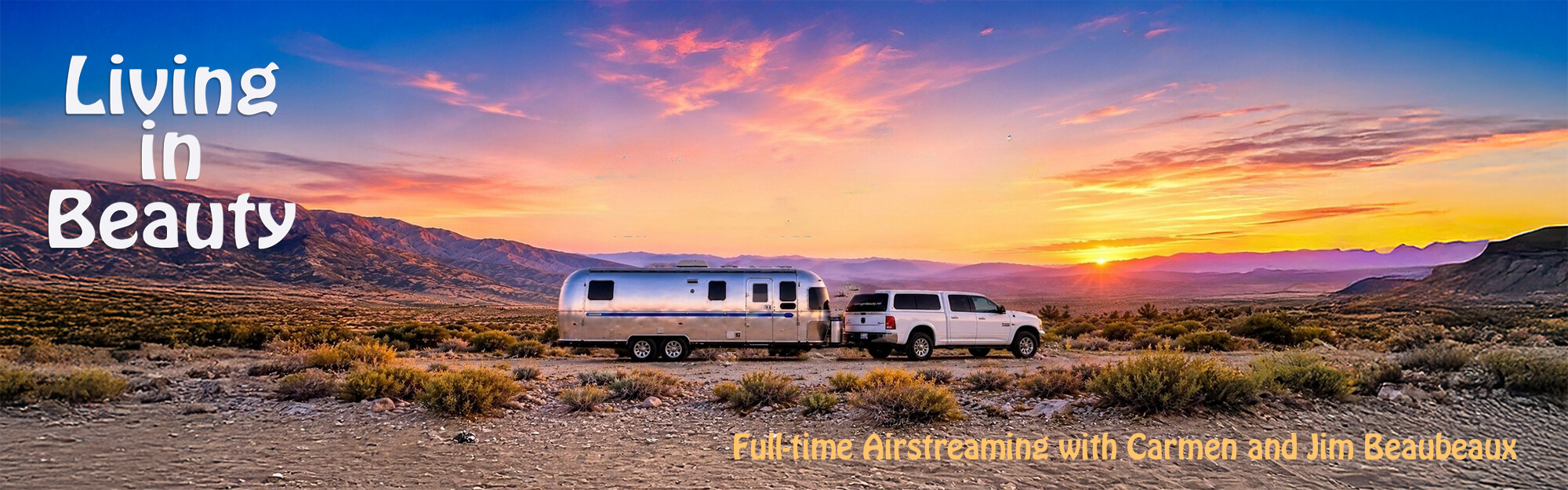
Over the years, readers have asked us hundreds of questions about life on the road, our Airstream, aging, simplicity, travel, and how we make this unusual lifestyle work. These are a few of the most common questions.
About This Life
How long have you been living and traveling in Beauty?
We began traveling full-time in our Airstream in the summer of 2016, 3,744 days ago.
What made you decide to live this way?
After both of our mothers passed away around the same time, we began realizing that the life we kept dreaming about could not be postponed forever. We had always loved camping, traveling, and adventure, but after 41 years of marriage — and a lifetime of possessions, routines, and responsibilities slowly accumulating around us — we found ourselves longing for a simpler life with fewer things and more freedom to pay attention to what matters most.
Why did you choose an Airstream?
Part of it was family history. Carmen grew up hearing her father point out Airstreams on the highway as “the finest trailer ever built,” and when we finally asked him what kind of RV we should buy, his answer came immediately: “You’re looking for an Airstream.” Beyond the iconic shape, we were drawn to the thoughtful design, lighter weight, durability, and the idea of owning something built to last for decades. When we found Beauty, she simply felt right to us — like the beginning of the life we hoped to create.
We recently shared the full story of how we found Beauty and The Beast here.
What does “Living in Beauty” mean?
It means living in a way that allows us to truly notice the beauty around us — the landscapes, the people, the quiet moments, the adventure, and the freedom that comes from owning less. The name has always carried a double meaning: our Airstream is named Beauty, but it also reflects the beauty we discover by living more closely connected to the world around us.
Life on the Road
How do you decide where to go next?
Some of our travel decisions are practical: weather, road conditions, campground availability, family visits, or the changing seasons. But many of our favorite places happened because we followed curiosity or someone else’s recommendation instead of a strict plan. Over time, we learned that the most meaningful parts of travel are often the ones we never scheduled. We wrote more about how we plan our travels here.
How long do you usually stay in one place?
When we first began traveling, we moved far too quickly and eventually realized that constantly changing locations can make even beautiful places blur together. So we developed our “4-3-2 Rule”: drive no more than 4 hours, arrive by 3 PM, and stay for at least 2 weeks — although real life does not always cooperate. After nearly 10 years on the road, we have actually slowed down even more, sometimes staying a month or longer. Slower travel gives us time to settle in, develop routines, revisit favorite places, and experience everyday life more deeply.
Do you mostly stay in campgrounds or boondock?
Over the years we have stayed everywhere from full-hookup RV resorts to remote public lands with no services at all. Campgrounds often provide community and comfort, while boondocking offers a quieter kind of solitude and connection to the landscape. We have learned to appreciate both depending on the season, the location, and what we need at the time. Here is a breakdown of where we camp.
What do you do all day?
Much of our life on the road looks surprisingly ordinary. We hike, bike, kayak, walk the dog, write, read, grocery shop, explore new places, meet interesting people, fix whatever just broke, and spend quiet evenings outside talking beside the fire. The scenery changes, but everyday life still comes with routines, responsibilities, curiosity, adventure, and small moments we have learned not to take for granted. If you’re curious what that ordinary day actually looks like, we invite you to spend A Day in Beauty with us.
Living Small
Was downsizing difficult?
Surprisingly, downsizing became easier as we went along. What began as the intimidating process of sorting through four decades of accumulated possessions slowly turned into the freeing realization that we needed far less than we once believed. Over two years, we gradually let things go, often setting aside items we thought we could never part with, revisiting them later with fresh perspective. Much of that journey became the inspiration for “The Clearing”, where we share more about how simplifying our lives changed us in ways we never expected.
Do you ever miss having a traditional home?
No. Seriously, no. We loved our traditional houses and still appreciate many things about that kind of life. But over time we’ve felt more freedom, less stress, and more fully alive living in less space and having fewer possessions to maintain. Beauty may be small, but after 10 years on the road, she is home to us — familiar, comforting, and filled with the memories, routines, and rituals that matter most in our lives.
Traveling Together
How do you make full-time travel work as a couple?
We are very different people with contrasting habits, schedules, and personalities, but after all these years we still genuinely enjoy sharing this life together. Living in a small space has not created new relationship problems so much as magnified the importance of communication, patience, humor, personal space, and respecting each other’s differences. Much of that experience inspired “Prickly Pair”, where we wrote more honestly about the realities of traveling together full-time.
Do you ever get lonely?
Rarely. Travel does not erase ordinary human longings for family, friendship, familiarity, or community. But surprisingly, we often see family and old friends more now because we eventually make our way to where they live — while bringing our own bed and toilet with us. Along the way, the road has also introduced us to unexpected friendships, meaningful conversations, and the quiet companionship of experiencing life together.
Practical Questions
What does full-time travel cost?
The honest answer is: it depends entirely on how you travel. Full-time RV living can cost far less than many people imagine or far more than expected depending on pace, campground choices, fuel prices, maintenance, and lifestyle. We track and share many of our actual travel statistics, costs, routes, and campground history on our Travel Maps & Facts page.
How do you receive mail and packages on the road?
We use a digital mail service called iPostal1, which has handled our mail since we began traveling full-time in 2016. We can view the outside of every piece of mail online, choose whether to scan it, discard it, or have it forwarded to wherever we happen to be staying at the time. It has worked remarkably well for 10 years and allows us to maintain a permanent mailing address while constantly moving.
How do you handle healthcare while traveling full-time?
Traditional Medicare has actually made healthcare on the road easier because we are not limited to one local network of doctors. While traveling, we usually rely on urgent care clinics when something unexpected comes up, but we still return to San Diego periodically for regular doctors, specialists, tests, and annual checkups. Prescriptions can usually be mailed directly to wherever we are camping, sent General Delivery to a nearby post office, or forwarded through our mail service when needed.
How do you make money while traveling full-time?
We are retired, so unlike many younger full-time travelers, we are not working remotely while traveling. Before hitting the road, Jim worked as a CFO and spent decades investing consistently and contributing heavily to retirement accounts, which eventually allowed us to retire at age 61. Today, our Social Security income covers most of our everyday living expenses, while investments help with larger unexpected costs like repairs, maintenance, medical expenses, or upgrades. And Carmen’s works sporadically as a voice-artist. The website itself generates only a very small amount of income through Amazon affiliate links.
Looking Back
Is full-time RV life really as carefree as it looks online?
No. Like any life, full-time travel includes breakdowns, bad weather, repairs, wrong turns, disappointments, exhaustion, unexpected expenses, and ordinary stress that rarely makes it into beautiful photographs. We tend to share the best moments more than the tedious or difficult ones, not because we are hiding reality, but because we try not to live focused on the worst parts. Over time, we have learned that the mishaps, detours, and imperfect moments often become part of the story. Much of that honesty inspired “Trust Us, We Lie”.
What has been the hardest part of this lifestyle?
The hardest part changes over time. Sometimes it is distance from people we love. Other times it is uncertainty, aging, weather, repairs, or simply the constant need to adapt. Full-time travel gives a great deal, but it also asks something in return. You have to let go of certain forms of comfort in order to receive others.
Would you do it all over again?
Yes. Not because every mile has been easy, and not because we have done everything perfectly. We would do it again because this life allows us to experience years we might otherwise have spent waiting, postponing, or simply living more cautiously. It has taught us to pay closer attention, laugh more easily when plans fall apart, and appreciate the value of time, health, and shared adventure.
What has been your favorite place?
There is honestly no way to choose just one. We have stayed in more than 500 locations. Some places astonish us with scenery, others with kindness, peace, history, weather, wildlife, or simply how they made us feel at a particular moment in life. Over time we have learned that our favorite places are often connected less to geography and more to the experiences, people, and memories we carry away with us.
What has been the best part of living this way?
The best part has been discovering how much lighter life can feel with less debt, fewer possessions, and less time spent maintaining things. We love experiencing the beauty of North America through its landscapes, people, cultures, food, and unexpected adventures — all while waking up every few weeks in the same home with a completely different front yard. But more than anything, the best part has been sharing this life together.
What advice would you give someone dreaming about this lifestyle?
Just do it! There will never be a perfect time, perfect plan, perfect budget, or perfect moment when everything suddenly feels safe and certain. Stop waiting for fear to disappear before beginning. One of the most surprising things we learned is that the life we were dreaming about was not hiding somewhere far away from us. It was waiting on the other side of finally giving ourselves permission to live it.